Definition

The Quality Assurance Center at Latakia University seeks excellence and works on continuous improvement and development of the quality of inputs, processes, and outputs through an integrated system of evaluation, supervision, monitoring, and support for all institutional and academic components and practices, in accordance with the university's vision, mission, and objectives, and fulfilling the requirements of approved standards. This is achieved through cooperation and mutual interaction with local and external units, centers, and bodies working in educational quality assurance, in order to gain community confidence in the university's role, outputs, and developmental capabilities in the Syrian Arab Republic.
| Department / Unit | Head / Responsible Person | Key Responsibilities & Duties |
| Administrative Director | Mr. Maher Obeid | • Overseeing administrative tasks and operations of the Center. • Supervising and managing the Center's administrative staff. |
| Internal Audit & Follow-Up Department | Dr. Bassem Barhoum | • Developing a guidebook on the methodology for establishing quality systems in the university. • Providing technical support to university administrations, faculties, and higher institutes. • Constructing and updating assessment and review metrics and standards. • Planning and monitoring internal audit operations conducted by the Center. • Publishing an annual report on quality programs and projects. |
| Planning & Documentation Department | Dr. Abeer Ateereh | • Contributing to setting the university quality assurance strategy, monitoring its implementation, and periodically evaluating it. • Establishing mechanisms to evaluate quality plan execution by comparing them against outcome indicators. • Developing model methods for data collection, report preparation, and indicator analysis. • Creating an integrated database for all quality-related matters. |
| Training & Media Department | Dr. Anna Ahmad | • Spreading quality culture within and outside the university community. • Conducting training courses, workshops, lectures, and seminars. • Following up with alumni and strengthening university-alumni relations. • Publishing periodic introductory bulletins in Arabic and English, and managing the Center's website. |
| Educational Process Quality Assurance Department | Dr. Alaa Taweel | • Participating in executing national plans and programs related to educational quality. • Designing templates for academic program and course specifications, as well as questionnaires. • Assisting faculties in preparing for institutional or academic program accreditation. • Supporting faculties in adopting and applying Academic Reference Standards (ARS and NARS). |
| Scientific Research & Community Service Quality Assurance Department | Dr. Sharif Hayek | • Designing questionnaires related to scientific research and community service, monitoring their implementation, and evaluating results. • Supporting faculties and higher institutes in planning and executing research projects. • Establishing communication channels with local and international entities related to research and community service. |
| Human Resources & Administrative Development Department | Dr. Afraa Ali | • Developing and building academic human capabilities (courses, conferences, workshops). • Contributing to job descriptions and administrative development in coordination with the Directorate of Administrative Development. |
| Ranking Office | Dr. Ammar Abbas | • Tracking and analyzing global university rankings (such as QS, Times Higher Education, Shanghai). • Collecting and analyzing required academic and statistical data from faculties and units. • Providing recommendations to improve performance indicators, academic reputation, and liaising with ranking bodies. |
Tasks
To achieve its goals, QAC
performs the following tasks:
1- Setting up the general
policies that achieve the QAC's goals.
2- Setting up the quality
assurance strategy at the university, updating and developing it periodically,
and supervising its implementation.
3- Setting up mechanisms for
evaluating the university administrations and following up their implementation
and development.
4- Working on implementing the
national plans and programs related to developing the quality of higher
education.
5- Participating in preparing
the strategic plan of the university.
6- Developing and building
human capabilities at the university to achieve the quality assurance system
and its continuous development.
7- Following up the work of Quality
Assurance Units at faculties and higher institutes, and determining the extent
of their effectiveness in implementing quality assurance mechanisms within the faculty/institute
through analyzing and evaluating the periodic reports of these units.
8- Providing the necessary
support for faculties and higher institutes and preparing them to apply for
institutional or academic accreditation for their programs whether internally
or externally.
9- Establishing communication
channels with the relevant units, centers and bodies that work in the field of
quality assurance and accreditation at higher education.
10- Proposing incentives and
rewards for distinguished activities at the work of QAC and Quality Assurance Units.
11- Considering the rules
governing the quality, excellence and creativity awards at the university.
12- Creating integrated
databases for all quality fields at the university.
13- Doing studies and
providing research in the field of quality and accreditation at higher
education, and publishing them in specialized periodicals and publications.
Activities
Activities Implemented at the Quality Assurance and Accreditation Center for the Year 2025 and Future Activities for the Year 2026
First: Regarding Arab and International Rankings
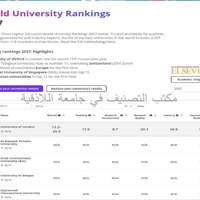
- Latakia University (formerly Tishreen) topped Syrian universities for the first time in its history in the Times Higher Education (THE) Impact Rankings for the year 2025.
- It ranked second according to the UNIRANKS® 2025 ranking of Syrian universities.
- Latakia University maintained a distinguished position in the Webometrics global ranking issued in July 2025, ranking 4,237 globally among more than 31,870 classified universities worldwide, and 2,185 among Asian universities, in a new achievement reflecting its standing.
- Lattakia University entered the Arab University Rankings (AU Rankings) for 2025.
Second: Regarding the Establishment of Regulations, Plans, Models, and Mechanisms
- The internal regulations for the center and the quality assurance and accreditation units in faculties and higher institutes were prepared, and the decision to adopt them was issued by the University Council.
- The following surveys were updated: "Student Opinion on Course Content and Teaching," "Labor Market Opinion Survey," and "Graduate Opinion Survey."
- The following models were updated: Program Description – Course Description.
- Mechanisms were established for: Program Vision, Mission, and Objectives – ARS – Preparation of Development Plans.
- Plans for the departments of the Quality Assurance and Accreditation Center for 2025 were developed.
- Development plans for the university's faculties and higher institutes for the academic year 2025-2026 were evaluated.
- Videos were recorded to explain how to develop plans, conduct SWOT analysis, and implement what has been achieved in faculties and higher institutes according to the models.
Third: Regarding Proposals
- A proposal was submitted for the organizational structure of the university's faculties after adding scientific offices (Academic Advising – Measurement and Evaluation – Graduate Follow-up – Activities and Community Service), along with job description cards for administrative positions, faculty staffing needs, and performance evaluation cards for different employee categories.
- A proposal was submitted regarding the distribution of staff within the faculty according to the proposed structure.
- A proposal was submitted regarding the employee evaluation form.
- A proposal was submitted regarding the university's strategic plan for the years 2026 to 2028.
- A proposal was submitted regarding improving the university's ranking, and another proposal regarding developing the university journal.
- A plan for experts for the year 2026 and internal and external training was submitted.
- Observations and proposals from the Quality Assurance Center were submitted regarding the University Organization Law.
- Observations and proposals from the Quality Assurance Center were submitted regarding Lattakia Governorate's proposals to improve education and enhance state service.
- Proposals were submitted regarding projects aligned with the programs of the Ministry of Higher Education.
- Proposals were submitted regarding activities and projects aligned with the requirements of our field of work to address ALECSO.
Fourth: Activities and Participation
- A training course was conducted on "Formulating Automated Questions According to Quality Standards."
- Participation in the Scientific Research Ethics Committee.
- Participation in the Digital Transformation Committee.
- Activation of the intranet service to document data for the work of the Quality Assurance and Accreditation Center and the quality assurance and accreditation units in faculties and higher institutes.
Activities for the Year 2026
- Launch of the project to update ARS and describe programs and courses at the university level.
- Follow-up on training courses on formulating automated questions.
- Work on issuing the Quality Assurance and Accreditation Guide for the university's faculties and higher institutes.
- Completion of guides related to (Academic Advising – Measurement and Evaluation – Graduate Follow-up – Activities and Community Service).
- Submission to Arab and international rankings.
- Activation of the updated offices at the Quality Assurance and Accreditation Center (Academic Advising – Measurement and Evaluation – Graduate Follow-up – Activities, Training, and Community Service).
- Activation of the updated offices in faculties and higher institutes (Academic Advising – Measurement and Evaluation – Graduate Follow-up – Activities, Training, and Community Service).
- Qualification and training of administrative staff in the quality assurance and accreditation units.
Recent News
See Latest Center News & Announcements
22/10/2026
22/10/2026