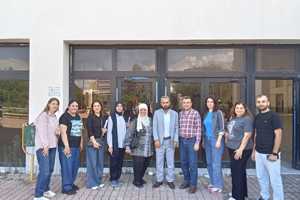
Details of the training program for the HANDS project team in Italy
The first day: 2-5-2022 from 10 am to 5 pm
The activities of the first day included introducing the participating teams and presenting the project activities in the participating universities, then the Faculty of Architecture at the University of Florence was introduced, and the team toured the college’s various departments and laboratories, the most important of which are (Graphic Design Laboratory, Workshops and Machinery Laboratory, Environmental Laboratory),
Where the mechanism of work within each laboratory was explained, how students benefit from modern equipment, the role of these laboratories in serving the university and society, and the mechanisms of linking them to what serves the "Hands" project.
Day 2: 3-5-2022 from 9:30 a.m. to 4:00 p.m.
On this day, the trainees were taken to a number of ancient traditional workshops in the old city of Florence, and the trainees were introduced to the mechanisms that are being worked on to preserve this style of traditional crafts, with sufficient explanations about their nature, their heritage, and their marketing in Italy and abroad.
Such as visiting a workshop for the Italian shoe industry (Stefano) and “baggage” suits, as well as perfumes and classic icons.
After completing the training tour, the team was taken to the artist Michelangelo's square, which is located near the sites of those workshops.
The third day: 4-5-2022 from 9 am to 4:30 pm
The activities of this day included a scientific tour to the city of Prato to visit the Museum of Textile and Clothing Industry, where the organizers reviewed the history of the textile industry, its sources and the machines that were used with explanations, pictures and various exhibits.
The tour ended with a training visit to the most important fabric recycling factories in the world, and the mechanisms of this industry and its importance in preserving natural resources were explained, passing through the traditional industries of these fabrics.
Fourth day: 5-5-2022 from 9:30 am to 2 pm
This day included two lectures, the first lecture was by Professor Antonella Trombadore, which was postponed from a previous day on sustainable architecture, entitled (traditional vernacular architecture for green design and sustainable revitalization of place).
It is about the importance of sustainability in architecture, and she also presented her team's experience in environmental design and green architecture by participating in various architectural competitions, some of which she won.
The second lecture was given by Dr. Claudia Morea, entitled: (LCA on traditional craft and eco-design criteria).
It was about the role of environmental design in traditional crafts and the role that the environmental aspect plays in modern designs.
A fruitful discussion took place at the end of each lecture, which reinforced the goals set for the training workshop.
Fifth day: 6-5-2022 from 9 am to 2 pm
The apprentices were taken to an area halfway to Pisa, the destination of which was a museum, an institute and a pottery factory.
The trainees were introduced to the history of the porcelain and ceramic industry in Italy by visiting a museum that includes distinctive exhibits arranged historically, which were gifts to kings and princes of the world from Italian ceramics throughout history.
Likewise, the educational institute was visited next to the museum, managed by one of the most important artists specialized in this field, and it is not required that the person wishing to learn hold scientific degrees as much as he needs the passion and talent to learn this art.
And then visit the accompanying factory, which was founded by a businessman in partnership with one of the most important artists since the 15th century, more than 500 years ago.
The trainees found how they invested in this ancient history and turned it into a factory where dozens of great artists rotated over the artistic and creative supervision, and now the most important artifacts signed with the artists’ names and fingerprints are manufactured and exported… The industry developed with the development of the artistic stages from photography to abstraction, as you see many artifacts that belong to For multiple art schools, the trainees were shown some gold-plated statues that embody personalities such as Michelangelo, Leonardo da Vinci and others.